Fall Roof Inspection Checklist
for Mississippi Homeowners
A fall roof inspection in Mississippi should cover seven areas: shingles and granule loss, flashing and penetrations, gutters and drainage, soffit and fascia, attic ventilation and moisture, interior ceiling signs, and any storm damage accumulated over the summer. Catching problems now, before winter rain arrives and contractor schedules tighten, gives you time to handle repairs on your own timeline instead of in response to a January leak.
Mississippi’s fall season is not just cooler weather. From September through November, the Mid-South region still sees occasional severe weather while experiencing wide temperature swings that accelerate wear on roofing materials. Southaven and DeSoto County homeowners who schedule a thorough inspection at the end of summer are in the strongest position to deal with any damage while repair windows are still open.
This checklist covers what you can safely check from the ground, what a professional inspection adds, and what to do if problems turn up.
Why Fall Is the Right Time to Inspect Your Roof in Mississippi
The National Roofing Contractors Association recommends that homeowners have their roofs inspected twice per year: once in spring, and once in fall. For Mississippi homeowners, the fall inspection serves a specific purpose. It closes out storm season.
Mississippi sits within the region storm researchers call “Dixie Alley,” where severe weather including hail, high winds, and tornadoes is most concentrated from spring through early fall. By September, most of the season’s highest-risk weather has already passed through. A fall inspection lets you identify and document any damage from those events before evidence is obscured by additional weathering or the passage of time.
The fall window also gives you enough warm-weather days to schedule and complete any needed repairs before year-end, when contractor schedules fill up and material lead times can stretch.
Area 1: Shingles and Granule Loss
Stand back from each side of the house and scan the shingle field from the ground. Use binoculars if needed. Look for:
- Missing or visibly displaced shingles. Any gap in the surface is a point where water can reach the underlayment.
- Curling or buckling at shingle edges. Shingles that are lifting or cupping at the corners are near the end of their serviceable life.
- Dark patches where shingles look bare. Accelerated granule loss leaves the underlying asphalt mat exposed. You will also find the shed granules sitting in your gutters.
- Shingles sitting at a different angle from the surrounding field. Wind events can lift and partially separate shingles without fully removing them.
Do not climb the roof to do this check. The ground-level view plus binoculars gives you enough information to know whether a professional inspection is warranted.
Area 2: Flashing and Penetrations
Flashing seals every joint where the roof plane meets a vertical surface: chimneys, dormers, walls, and pipe boots. From the ground:
- Check that flashing appears flush and intact at each chimney corner and base.
- Look for any visible separation, rust, or lifted sections at wall-to-roof intersections.
- Scan pipe boots and vent collars for cracking or missing sealant. Neoprene pipe boots are one of the most common leak points on Mississippi roofs.
Flashing failures rarely announce themselves as obvious gaps. A professional inspection with close access to each penetration is the only way to assess sealant integrity and fastener condition.
Area 3: Gutters and Drainage
Gutters do not directly protect the roof, but a blocked or damaged gutter system causes water to back up against the roofline and fascia, which can lead to rot and water entry.
- Look for sections of gutter that are visibly sagging or pulling away from the fascia.
- Check downspouts to confirm they are attached and discharging away from the foundation.
- After your next rain, observe whether water flows freely through the downspouts or overflows the gutter edge. Overflow means a blockage exists somewhere in the run.
- If you can see granules layered in the bottom of the gutter without water present, that is a sign of significant shingle wear.
Area 4: Soffit, Fascia, and Roofline
The soffit is the horizontal surface under the roof overhang; the fascia is the vertical board at the roofline edge. Both are common targets for moisture damage and pest entry.
- Look for soft, discolored, or peeling paint on the fascia board. This often indicates a gutter has been overflowing and running down the face of the board.
- Check soffit panels for staining, bowing, or gaps. Gaps in the soffit allow water and pests into the attic space.
- Scan the roofline edge for drip edge that is bent, lifted, or missing sections.
Area 5: Attic Ventilation and Moisture
The attic is part of the roof system. Inadequate ventilation causes heat and moisture to accumulate, which degrades shingles from below and leads to mold growth in the attic space.
- Access the attic on a sunny day and look for any points where daylight is visible through the decking or at the roofline. Daylight means water can enter the same way.
- Look for staining or dark discoloration on the underside of the decking or rafters. This indicates previous or ongoing moisture intrusion.
- Check insulation for wet or compressed sections, which indicate water has reached the attic floor.
- A musty smell in the attic is a reliable sign of ongoing moisture accumulation even without visible staining.
Area 6: Interior Ceiling Signs
Walk through the upper floors and look at the ceilings and upper walls from the inside:
- Water staining on the ceiling, particularly in corners or directly below the roofline.
- Bubbling, blistering, or peeling paint on upper-floor walls near exterior surfaces.
- Any brown rings or tide lines on ceiling drywall. These indicate water has reached the ceiling surface at some point, even if it appears dry now.
Interior signs are often the first thing homeowners notice because they appear at eye level. When they show up, the leak source has typically been present for longer than the staining suggests.
Area 7: Storm Damage Assessment
After a summer of severe weather across North Mississippi and the Mid-South, many DeSoto County roofs are carrying storm damage that has not yet produced visible leaks. The most common findings on fall inspections in Southaven and the surrounding area include:
- Hail impact bruising on asphalt shingles, which appears as dark depressions in the granule layer. These are not visible from the ground but are clearly identifiable on close inspection or drone photography.
- Lifted or cracked flashing following high-wind events.
- Creased shingles along the ridge from wind-lifting, which weakens the bond between the shingle layers.
According to the Insurance Information Institute, hail and wind account for more than 45% of total homeowners insurance claims paid in the United States each year. In Mississippi, where storm season runs longer than the national average, fall is the window to identify whether your roof absorbed insurable damage before claim timelines begin to close.
What a Professional Inspection Adds to This Checklist
A ground-level walk tells you what you can see. A professional inspection tells you what is actually happening on the roof surface and in the structure below it.
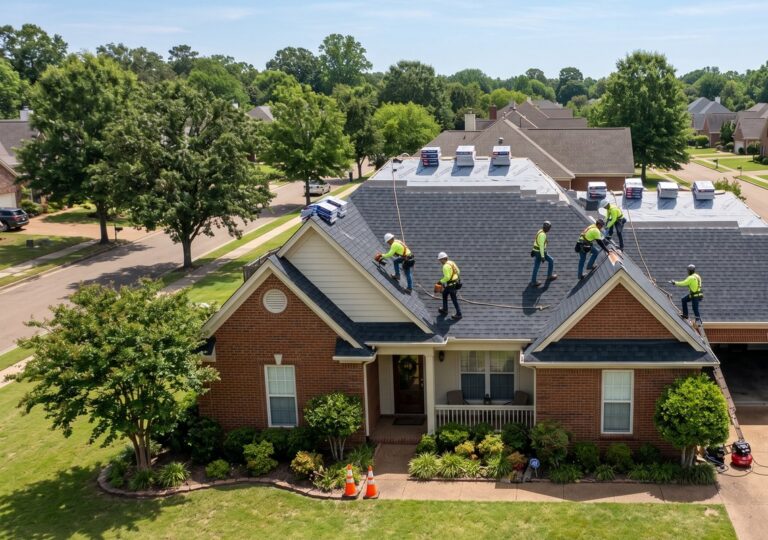
Ultimate Roofing uses drone inspection technology for residential assessments across Southaven, Hernando, Olive Branch, and all of DeSoto County, Mississippi. Every section of the roof is documented in high-resolution photography before anyone steps on the surface. A professional inspection includes:
- Full shingle surface assessment on every slope, including hail impact pattern identification.
- Close-up flashing evaluation at every chimney, wall, and penetration.
- Decking and underlayment condition where access allows.
- Attic walkthrough with documentation of moisture or ventilation issues.
- Written inspection report with photographs, suitable for insurance documentation.
If the inspection reveals insurable storm damage, that written report and photo documentation is what you bring to your insurance company before the adjuster arrives. Homeowners who have an independent contractor’s report in hand before opening a claim are in a substantially stronger position than those who call insurance first. For more on how to use an inspection report to support a claim, see our storm damage page.
FAQ: Fall Roof Inspections in Mississippi
How much does a professional roof inspection cost in Mississippi?
Many licensed roofing contractors in the Southaven and DeSoto County area, including Ultimate Roofing, offer free inspections. The free inspection allows the contractor to document conditions accurately before providing a repair or replacement estimate. It is standard practice, not a sales tactic.
How long does a professional roof inspection take?
A complete inspection of a typical residential roof in Southaven or the surrounding area, including the drone pass and attic walkthrough, takes approximately 45 to 60 minutes. Budget additional time to review the findings with the contractor on-site.
Can I do the inspection myself?
You can safely conduct the ground-level portion of this checklist. What you cannot assess from below are hail impact bruising on the shingle surface, the condition of the underlayment, the integrity of flashing sealant, or the full scope of any moisture infiltration in the decking. For insurance purposes, your own visual assessment does not substitute for a licensed contractor’s written report.
How often should a Mississippi roof be inspected?
Twice per year is the standard recommendation: once in spring and once in fall. After any significant storm event in DeSoto County, schedule an additional inspection within one to two weeks regardless of the calendar. Hail and wind damage that is documented promptly is far easier to support in an insurance claim than damage documented months later.
What if the fall inspection reveals damage I wasn’t aware of?
Get the written inspection report and photos from your contractor, then open an insurance claim with that documentation in hand before the adjuster visits. Your contractor can also meet the adjuster on-site and walk the roof with them, which typically results in a more complete approved scope than an adjuster review conducted alone.
Schedule Your Free Fall Inspection Today
Serving Southaven, Hernando, Olive Branch, Collierville, and all of DeSoto County, Mississippi, Ultimate Roofing provides free drone roof inspections so homeowners know exactly where their roof stands heading into winter.
Call (662) 331-3000 or request your free inspection online. We are a licensed Mississippi contractor (R18259), A+ BBB accredited, and an Owens Corning Preferred Contractor. We have served Mississippi and Tennessee homeowners since 2007 and can typically schedule fall inspections within a week of your call.
For a full overview of our inspection services, visit ultimate-roofing.com/roof-inspection/.
Ready for a Free
Fall Roof Inspection?
We document your roof before winter across Southaven, Hernando, Olive Branch, and all of DeSoto County. No pressure and no obligation.