
Flat Roof Repair
Mississippi
Installation & Systems
TPO, EPDM, PVC, modified bitumen, and built-up roofing systems for commercial buildings, residential additions, garages, and multi-family properties across Mississippi and Tennessee. Expert installation. Correct drainage. Free estimates.
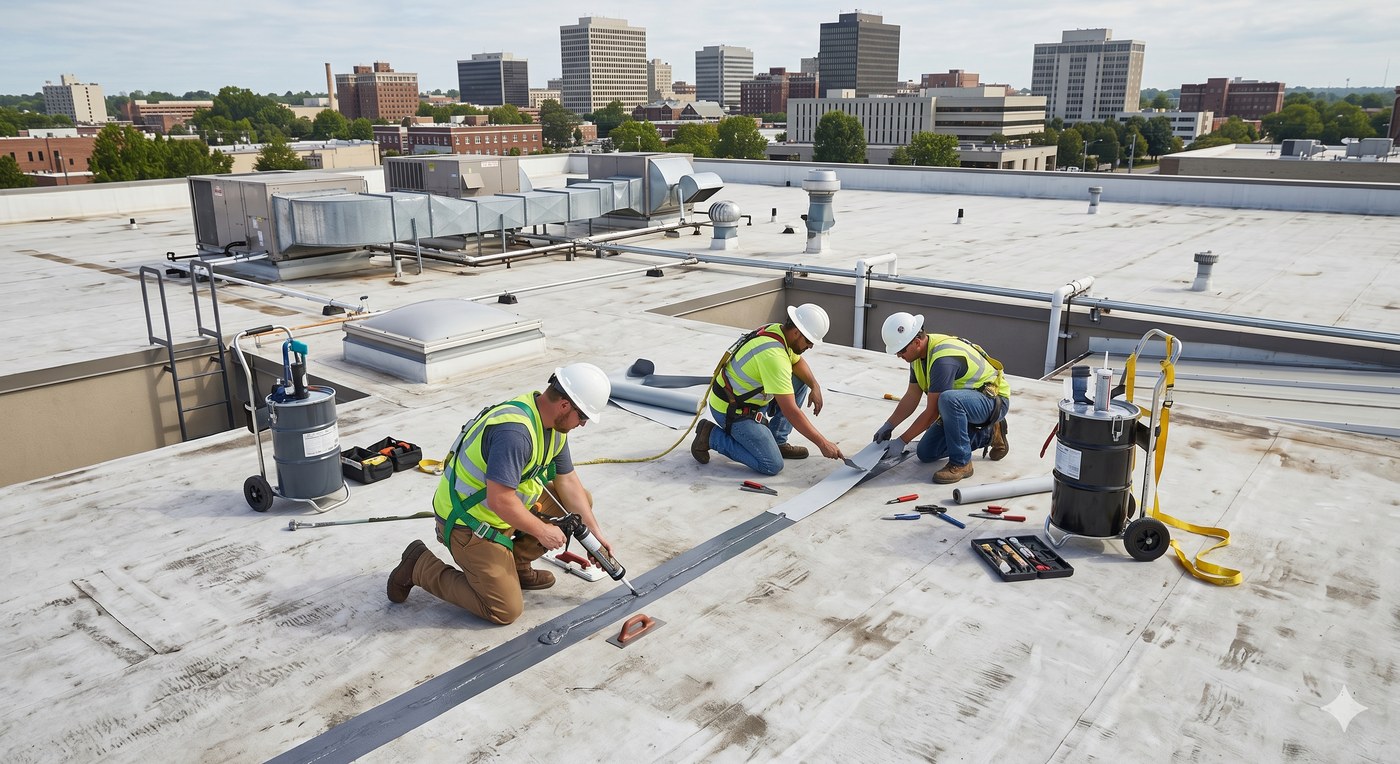
Flat Roofing Systems We Install
Flat and low-slope roofing is a category, not a single product. Each membrane system has different strengths, cost profiles, and ideal applications. We work with all major systems and recommend the right one for your specific building and use case.
TPO is the most widely specified flat roofing membrane in North America today — and for good reason. It is lightweight, highly reflective (reducing cooling costs in Mississippi’s hot climate), and features heat-welded seams that create a bond stronger than the membrane itself. Unlike adhesive-seamed systems, welded TPO seams do not dry out, peel, or separate over time. TPO is resistant to UV radiation, ozone, and chemical exposure. Available in 45, 60, and 80 mil thicknesses, TPO works on commercial buildings, retail, churches, warehouses, and residential applications alike. It is our most-recommended system for new commercial flat roof installations in DeSoto County and across Mississippi.
EPDM is a durable synthetic rubber membrane that has been the commercial flat roofing standard for decades. Its primary advantages are cost-effectiveness, flexibility across a wide temperature range, and a proven long-term track record. EPDM is available in large sheets that minimize seam count — important because seams are the most common failure point on any membrane roof. It is highly resistant to UV degradation and performs well in Mississippi’s climate with proper installation. EPDM is often the right choice for smaller commercial buildings, budget-conscious projects, and re-roofing applications where cost control is the primary driver.
PVC roofing membranes share TPO’s heat-welded seam advantage while adding superior resistance to chemical exposure — making PVC the right choice for restaurants (grease-laden exhaust), industrial facilities, or anywhere chemicals may contact the roof surface. PVC is also highly resistant to fire and puncture. It has been used on commercial roofs for over 50 years and carries a well-documented performance history. The installed cost of PVC is typically higher than TPO or EPDM, but for buildings where chemical contact is a concern, the additional investment is clearly justified. PVC is also a strong choice for roof areas with significant foot traffic.
Modified bitumen is an asphalt-based system reinforced with polyester or fiberglass and modified with APP or SBS polymers for improved flexibility and UV resistance. It is installed in multiple plies — typically a base sheet and cap sheet — which provides redundancy not found in single-ply systems. Mod bit is highly resistant to puncture and foot traffic, making it suitable for roofs with regular HVAC maintenance access. It can be torch-applied, cold-applied, or self-adhering depending on the application and safety requirements. Modified bitumen is a proven system with a 15–20 year lifespan and is frequently used on small commercial buildings, multi-family properties, and residential low-slope additions throughout Mississippi.
Built-up roofing is one of the oldest and most proven flat roofing systems, consisting of multiple alternating layers of bitumen and reinforcing fabric topped with a cap sheet or aggregate surface. BUR’s multi-ply construction provides excellent redundancy — if one layer is compromised, the others continue to protect the building. It is highly resistant to UV degradation, foot traffic, and puncture. Properly maintained BUR systems can exceed 30 years of service. While installation is more labor-intensive than single-ply systems, BUR remains a strong choice for large commercial roofs, historical buildings, and situations where maximum durability and longevity are the priority over initial cost.
Common Flat Roof Problems We Diagnose and Fix
Flat roofs fail in predictable ways. Knowing what to look for — and addressing it before it becomes a major leak — is the difference between a repair and a premature full replacement. We have seen every failure mode listed below and know exactly how to address each one.
Schedule a Flat Roof Inspection-
Ponding WaterWater sitting on a flat roof more than 48 hours after rain indicates insufficient slope or blocked drains. Chronic ponding accelerates membrane degradation and adds structural load. We assess drainage, correct slope with tapered insulation where needed, and clear or add drains.
-
Membrane Splits and TearsMembranes expand and contract with temperature — significantly so in Mississippi’s climate. Over time, thermal cycling causes splits, especially at corners, penetrations, and areas of concentrated stress. Split membranes allow direct water entry and require prompt repair or replacement of the affected area.
-
Seam FailuresSeams are the most common failure point on any flat roof. Adhesive seams dry out and separate over time. Poorly welded TPO seams develop gaps. Failed seams allow water to infiltrate beneath the membrane surface — where it may travel far from the visible leak point before appearing inside the building.
-
Flashing DeteriorationWhere a flat roof meets a wall, parapet, curb, HVAC unit, or penetration, metal or membrane flashing creates the seal. Failed flashing at these transitions is one of the most common sources of commercial roof leaks — especially at HVAC curbs and parapet walls, which are high-movement areas subject to thermal stress year-round.
-
Blistering and BubblingBlisters on a flat roof membrane are pockets of trapped air or moisture beneath the membrane surface. Small blisters are not always immediate leak sources but indicate compromised adhesion that will deteriorate. Large blisters can rupture under foot traffic or thermal stress, creating open leak points. We assess whether blisters require repair or indicate broader adhesion failure requiring replacement.
Flat Roof Repair vs. Replacement — How We Decide
The right answer depends on the membrane’s age, the scope of failure, and whether the deck beneath is structurally sound. Here is how we assess each situation — and how you can think about it before we arrive.
- The membrane is under 15 years old and in overall good condition
- Failure is localized — a split seam, puncture, or isolated flashing failure
- The roof deck beneath is dry and structurally sound
- The leak is recent and has not caused widespread water infiltration under the membrane
- The roof has not been repaired repeatedly in the same area
- A repair extends useful life by 5 or more years at a fraction of replacement cost
- The membrane is at or past its expected lifespan
- Multiple failure points exist across the roof surface
- The deck beneath has sustained moisture damage or structural compromise
- Widespread blistering or adhesion failure indicates the membrane is no longer sound
- Chronic ponding has accelerated degradation across a large area
- The cost of continued repairs approaches or exceeds replacement value over time
We give every flat roof customer a straight answer about which situation applies to them — not the recommendation that generates the larger job. If repair is the honest answer, we will tell you that. If replacement is clearly necessary, we will explain why and back it up with what we found during inspection.
Why Drainage Is Critical on Mississippi Flat Roofs
Mississippi receives an average of 55 to 65 inches of rainfall annually — among the highest in the continental United States. In summer, intense convective storms can dump two to four inches of rain in under an hour. On a flat roof, this volume of water must move to drains or scuppers immediately. Any obstruction, inadequate drain sizing, or insufficient roof slope creates ponding conditions that stress the membrane far beyond its design intent.
A properly designed flat roofing system in Mississippi is not simply waterproof — it is engineered to move water off the roof surface quickly. This means correct roof slope (minimum 2% toward drains), correctly sized primary drains, overflow drains or scuppers as backup, and debris management to keep drain areas clear. When we install a new flat roof or assess an existing one, drainage is never an afterthought. It is the design starting point — because in Mississippi’s rainfall environment, even a watertight membrane will eventually fail if water is sitting on it constantly.
Get a Drainage Assessment- Mississippi averages 55–65 inches of rain per year — drainage is a design priority, not an afterthought
- Minimum 2% roof slope to drains is required for all flat roof installations we perform
- Tapered insulation used to correct slope on existing roofs with drainage problems
- Overflow drains and scuppers specified wherever primary drain failure would cause structural overload
- Drain collars and flashing fully integrated with the membrane for watertight connections
- Post-installation drainage review confirms correct water movement before project is closed
Why Mississippi Property Owners
Trust Ultimate Roofing
for Flat Roofs
Flat roofing is technical work. A watertight seam requires correct temperature, technique, and materials. Proper drainage requires understanding how water moves across a surface. These are not skills every contractor has — but they are skills we have built our commercial roofing reputation on.
Get a Free Flat Roof Estimate- Experience with TPO, EPDM, PVC, modified bitumen, and BUR systems
- Proper seam welding technique — not rushed, not cut short on overlap
- Drainage assessment included with every flat roof inspection and installation
- A+ BBB Accredited — verified commercial and residential reputation
- 4.9 stars across 57 Google reviews — homeowners and commercial clients
- Licensed Mississippi roofing contractor — License R18259
- Honest repair vs. replacement assessments — we do not push replacement to inflate a ticket
Our Flat Roof Process
From initial assessment through final drainage check — here is what to expect when you work with Ultimate Roofing on a flat roofing project.
We inspect the membrane surface, seams, flashing, penetrations, drains, and deck condition. We document all failure points, assess drainage adequacy, and look for signs of moisture in the deck beneath — all at no charge.
We give you a clear answer: repair or replace, and why. We explain what we found, which failure modes are present, and what the options are for addressing them — including realistic lifespan and cost projections for each path.
Written, itemized estimate covering membrane, insulation, drainage modifications, flashing, labor, and any deck repairs required. No hidden charges. We explain every line item and answer every question before you commit.
Correct membrane attachment, properly welded or adhered seams, integrated flashing at all penetrations and transitions, and accurate slope to drains. We do not rush the work that determines whether your roof is actually watertight.
After installation, we verify that water flows correctly to all drains, that no ponding areas exist, and that all seams and flashing connections are sound. Site is cleaned completely before we leave.
Flat Roof Questions,
Answered Honestly
For most commercial and residential flat or low-slope applications in Mississippi, TPO (thermoplastic polyolefin) is the most widely recommended system. It offers strong UV resistance in a climate with intense solar exposure, heat-welded seams that are significantly more watertight than adhesive seams, good wind uplift resistance, and an installed cost that is competitive with EPDM. That said, the best system depends on your specific building. EPDM remains a cost-effective choice for smaller commercial buildings and residential additions. PVC is the right call where chemical resistance is needed — restaurant hood exhausts, HVAC condensate, industrial applications. Modified bitumen works well where foot traffic is expected. Ultimate Roofing assesses your building, drainage situation, and use requirements before recommending a specific membrane.
Flat roof lifespan varies significantly by system and installation quality. TPO membranes typically last 20–30 years when properly installed and maintained. EPDM has a similar lifespan of 20–30 years, with some well-maintained systems exceeding that range. PVC roofing can last 20–30 years as well, with strong resistance to UV exposure and chemical contact. Modified bitumen typically delivers 15–20 years. Built-up roofing can last 30 or more years when properly maintained. In all cases, installation quality — proper membrane attachment, seam welding or bonding, drainage design, and flashing — is as important as the material itself.
Ponding water on a flat roof — water that remains more than 48 hours after rain — is almost always a drainage problem. Common causes include inadequate slope during original installation (flat roofs should have a minimum 2% grade toward drains), clogged or undersized roof drains, debris accumulation blocking drain openings, structural deflection of the roof deck over time, or improper drain placement. In Mississippi’s heavy summer rain environment, ponding water is a serious issue. Standing water accelerates membrane degradation, adds structural load, and — if the membrane has any imperfection — creates constant hydrostatic pressure that forces water through. Addressing ponding water typically requires drain cleaning, slope correction using tapered insulation, or adding supplemental drains. We assess the full drainage picture during every flat roof inspection.
Many flat roof problems can be repaired rather than replaced — but the decision requires an honest assessment of the membrane’s overall condition, not just the visible failure point. If the membrane is in good overall condition, under 15 years old, and the failure is localized — a split seam, a puncture, a failed drain collar, or deteriorated flashing — repair is usually the right call. If the membrane is at or past its expected lifespan, has widespread blistering or splitting, has been repaired multiple times, or has chronic ponding accelerating deterioration across the entire surface, replacement delivers better long-term value. We will give you a straight answer about which situation you are in — and we do not recommend replacement to generate a larger job.
Yes. While flat and low-slope roofing is most commonly associated with commercial buildings, we install and repair flat roof systems on residential buildings throughout Mississippi and Tennessee. Common residential flat roof applications include low-slope home designs, flat-roofed additions such as sunrooms and covered patios, garages, carports, and multi-family residential buildings including duplexes and small apartment complexes. TPO and modified bitumen are the most common systems for residential flat applications. We bring the same installation standards to residential flat roofs that we apply to commercial projects — correct slope, proper membrane attachment, and careful attention to drainage.
Get a Free Flat Roof Assessment
Leaking, ponding, or just overdue for inspection — we will give you a straight assessment and a clear estimate. No pressure. No obligation.